
November 20, 2026
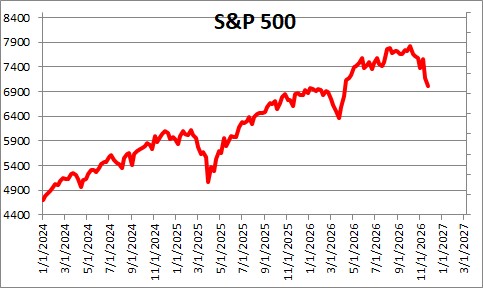
It was a rough week for the stock market. The Anthropic IPO caused investors to re- focus their attention on tech stocks and the extent to which they are overvalued. A correction is always painful but one that happens fairly often in any business cycle. Investors frequently get excited about something. There is suddenly a fear of missing out which pushes the market higher. It gets overvalued. At some point the fear factor sets in and the stock market corrects. We have had two corrections already in this business cycle. The first was in early 2025 when Trump introduced his draconian tariffs. The second was in March when the war with Iran started. Both were triggered by legitimate concerns and followed a period when the stock market had been climbing rapidly. In each case the stock market recovered quickly and the economy continued to plow ahead. This stock market downtown, in our opinion, is similar. But every now and then a stock market correction leads to an actual bear market which, in turn, becomes the catalyst for a recession. What is it this time? Our sense is that it is a correction and not a more ominous signal of an impending downturn.
The S&P 500 index reached a peak of 7819 on October 6. At 7014 as of midday Friday the S&P has fallen 10.0%. A correction is typically defined as a decline of 10.0% The S&P 500 has just experienced a correction. But corrections are a normal part of the business cycle. The markets get overly excited about something and rise very rapidly. Then there is some catalyst that causes investors to get nervous and there is a pullback. More often than not a correction is not a sign of an impending recession. As noted earlier, we have had two corrections in the past couple of years. The first was triggered by Trump’s imposition of massive tariffs in early 2025 as he was beginning his second term. The second occurred earlier this year as the war with Iran began. In both cases the markets shrugged off the declines and quickly recovered, and the economy was unfazed. Is this just another “correction”? We think so.
Typically, when the market enters “bear market” territory there is some other problem. Usually the culprit is the Federal Reserve which may have raised interest rate levels quickly to levels that are far above their so-called “neutral” level. That is not the case this time.
Unfortunately, nobody knows exactly what constitutes a normal level. It is unobservable which leaves economists guessing. Furthermore, the neutral rate can change depending upon exactly where the economy is in the business cycle. The Fed’s median estimate of the neutral rate is 3.2%. The current funds rate is 3.8%. If that is correct Fed policy is slightly restrictive. But if so, why is the economy continuing to chug along with GDP growth averaging a healthy 2.5%? Why isn’t the inflation rate continuing to slow? Why is the stock market (until this past week) remaining close to a record high level? While the Fed’s median estimate of the neutral rate is 3.2% about one-half of its FOMC’s members peg the neutral rate somewhere between 3.5-4.0%. We suggest it is about 4.0%. But the current funds rate is 3.8%. It may be roughly neutral, but it is hardly restrictive. Even if, as expected, the Fed hikes the funds rate by another 0.25% later this month and the funds rate climbs to 4.1% it would still be about neutral.
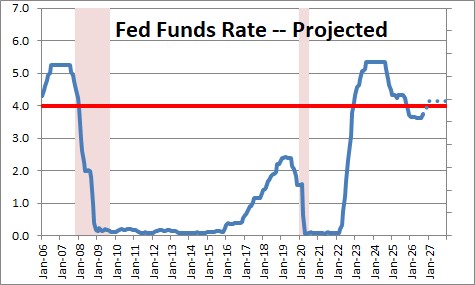
Could the Fed keep raising rates in 2027 and eventually over-do it? Of course. But that is not our call. We think the inflation rate will gradually subside next year which will keep Fed policy on hold. For what it is worth, the market expects the funds rate at the end of next year to be 4.5% compared to our 4.1% projection.
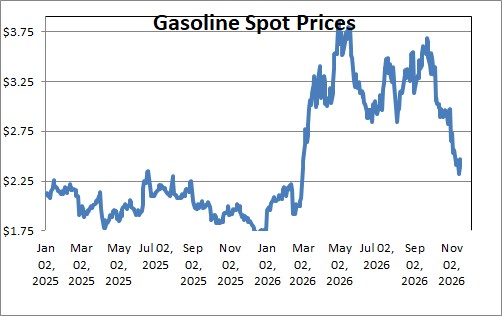
A big reason for optimism about a slowing rate of inflation is attributable to the recent decline in oil prices. Following the election it appears that investors believe there will not be an escalation in the war with Iran. Perhaps there will be some sort of negotiated settlement. Perhaps it is some sort of prolonged ceasefire. In either case oil prices have plunged. For example, spot prices for gasoline have fallen from $3.50 at the end of September to $2.47, a decline of about 30%. They are not too far from where they were prior to the war.
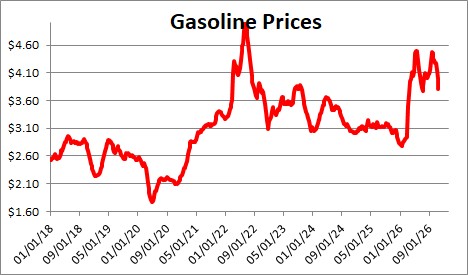
Pump prices have only declined about 15% from their peak which suggests that they should continue to slide to $3.50 per gallon or a bit lower.
What happens to oil prices is hugely important to the outlook for the inflation rate. In the past year the energy component of the CPI has risen 20%. It represents 7.5% of the index. That means that energy prices have added 1.5% to the overall CPI index in the past year. The year-over-year increase in the CPI is 3.9% currently. Subtracting 1.5% from that suggests that the inflation rate next year should slow sharply. For what it is worth, we expect both the overall index and the core rate to slow to 2.3% in 2027. If that is accurate, Fed policy should remain on hold throughout the year.
The bottom line is that the market is having a case of the jitters about AI and how quickly it may boost corporate earnings and by how much. That is a spirited and useful debate. AI presents unprecedented opportunities but it is difficult to price that into the market at any particular point in time. As we see it, firms have to invest in AI. If they do not, the competition will. Those other firms will be more productive and boost earnings. You will not and you will lag behind. At the national level the U.S. needs to continue to push ahead with AI. If it does not, China will. AI has already begun to boost productivity and even faster productivity growth seems certain to come. It is already boosting corporate earnings. It has encouraged entrepreneurship as the number of newly form firms has skyrocketed. Those firms are hiring workers and, if successful, will hire even more workers in the future. And as the economy’s speed limit quickens our standard of living will grow more rapidly. For all of those reasons we think that what we are dealing with right now is a stock market correction and not a precursor of recession.
Stephen Slifer
NumberNomics
Charleston, S.C.
Follow Me