
September 30, 2016
As we approach yearend and begin to turn our focus to next year, economists need to know what went wrong in 2016 and how those misses might impact growth next year. We are grappling with three important issues.
- Why has GDP growth been so slow?
- Will inflation ever begin to accelerate?
- How high do rates have to go?
GDP growth. In December 2015 we expected GDP growth this year of 2.6%. It now appears that growth will be about 2.0%. That is disappointing. Our miss was entirely attributable to the lack of investment spending. We expected such spending to rise 4.5% in 2016; it will decline by about 1.0%. Given that this category is 15% of GDP the shortfall in this single category accounts for all of our GDP miss.
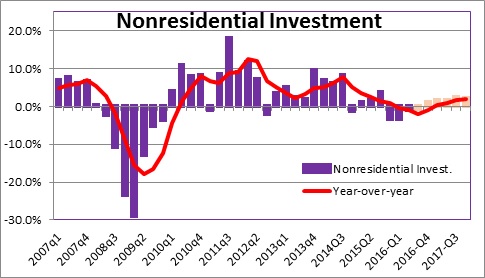
So what is going on? Business people should be cheered by the fact that stock prices are still rising. Consumers are spending freely. Corporate borrowing rates are at record low levels. Utilization rates in the manufacturing sector are relatively high. Inventory levels are lean. The fundamentals seem favorable. But, oddly, firms are willing to hire new workers, but simultaneously refuse to invest in the latest productivity-boosting technology or upgrade the equipment on their factory floor. Last week we described in some detail how this lack of corporate confidence can be traced to gridlock in Washington.
We believe corporate executives are frustrated by a variety of factors. Business leaders talk about the 39% corporate tax rate in the U.S. compared to an average of 23% elsewhere in the world. That is why companies are moving their operations overseas. In addition, profits earned from overseas operations are basically frozen there. After having already paid the local tax on those earnings they will get taxed again if they bring those funds back to the U.S. That means that Europe, Asia, and elsewhere are benefiting from U.S. investment in their country. They get a secondary benefit from the corporate taxes those U.S. companies are paying.
In addition, companies complain endlessly about the unnecessary, confusing, and often overlapping regulations imposed by the federal government.
Our highways, bridges, airports, ports, and rail systems are in desperate need of investment. The list goes on. In every case, the problems appear to be the result of inaction by policy makers in Washington.
We have an election in early November. If our politicians do not unwind the gridlock in January, the economy will remain in a sluggish 2.0% growth environment for the foreseeable future. If they are able to make changes in all or some of the items noted above, GDP growth could climb from 2.0% to 3.0%.
Inflation. The economy is allegedly at full employment. A shortage of skilled workers is supposed to be boosting wages which, in turn, should cause firms to boost prices. Inflation should be on the rise. While that is now happening it has taken a long time to begin.
To be sure, falling oil prices caused inflation to decline from October 2014 through the end of last year. But oil prices have been rising since January. At the same time slower growth in China caused commodity prices to decline. These factors that contributed to slow growth in inflation this year have reversed direction.

As shown below, we expect inflation to gradually work its way higher next year. The core rate of inflation for 2017 is expected to be 2.5% (versus 2.3% this year and 2.1% in 2015). Unfortunately, in the world of economics, economic growth and inflation do not always move gradually. Our fear is that oil and commodity prices continue to climb, tightness in the labor market begins to push wages higher, the shortage of available housing causes rents to climb, and medical costs suddenly gather upward momentum. That would be a game changer. It would force the Fed to raise rates far more rapidly than anybody envisions currently and threaten the expansion.

Interest rates. How high does the Fed need to raise short-term interest rates? Over the last 25 years in good times and bad the funds rate has averaged 1.5% higher than the inflation rate. Presumably, if the Fed puts the funds rate 1.5% higher than its 2.0% inflation target, or 3.5%, the funds rate would be “neutral”. But as it has become apparent that the economy can no longer grow at a 3.5% pace but probably something close to 2.0%, economists have been shifting this so-called “neutral” rate lower. They now suggest it should be something about 1.0%. If that is the case, the “neutral” funds rate should be 3.0%.
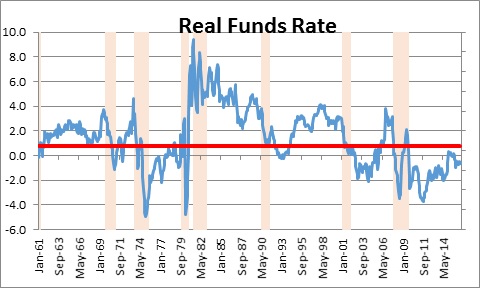
But there is nothing magic about 1.0%. The reality is that this so-called “neutral” rate is unobservable. You only figure it out after the fact. With the funds rate today at 0.4% and inflation at 1.1% the real rate is -0.7%. So while there may be some disagreement about exactly how high the funds rate eventually needs to be – probably somewhere between 2.5-3.0% — the funds rate today is far too low. Slow, gradual rate hikes will not threaten the expansion any time soon.
Stephen Slifer
NumberNomics
Charleston, S.C.
Follow Me