
June 3, 2011
Recent Wall Street Journal headlines are troublesome. “Slowdown in Growth is Becoming a Concern”, “Housing Imperils Recovery”, “Economic Outlook Darkens”. Then we see an increase in private sector employment for May of 83 thousand versus an average gain in the three previous months of 243 thousand. The unemployment rate rose 0.1% in May to 9.1% after having climbed 0.2% in April. Should we worry seriously about the pace of GDP growth going forward? Probably not.
In our opinion the economy has hit a soft patch during which growth will be lower than it otherwise would have been because of higher gasoline prices and an inability of manufacturers, particularly in the automobile industry, to get parts following the tsunami in Japan. However, that growth slowdown will be neither significant nor long lasting. Consider the following.
First of all, the Fed is on our side. It has kept the funds rate at 0.0%. Furthermore, it has created a record high level of excess reserves of $1.5 trillion. Excess reserves are funds that are available to the banking system to lend to consumers and businesses. The Fed is being as accommodative as it possibly can be. Knowing that fact alone should assure us that recent economic statistics do not represent the beginning of a significant, prolonged period of slow growth. The U.S. economy has never dipped into recession without the Fed first pushing interest rate levels sharply higher. The Fed’s current policy stance virtually guarantees that a drop back into recession is inconceivable.
Second, the stock market has largely shrugged off this combination negative events. The S&P 500 index is currently at 1,305. It reached a peak of 1,363 in late April. Thus, it has fallen just over 4% which, as shown below , is a barely noticeable drop that could easily be reversed by a couple of good days . If the economy was as weak as recent data suggest, or as bad as the headlines indicate, the stock market should have fallen much farther and faster. It hasn’t done that. Note also that last year, in response to the debt problems in Europe, the S&P fell 14% and the economy experienced nothing more than a single quarter of sluggish growth. A 4% drop in stock prices is hardly significant. A “correction” in the stock market is usually associated with a decline of 10%. We are not even close.

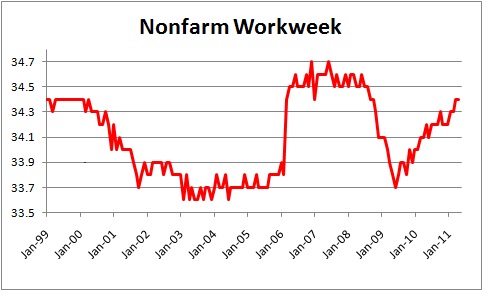
Third, the workweek for April was revised upwards from 34.3 to 34.4 hours. That may not sound like much, but it represents an increase of 0.3%. To boost production firms always have a choice of hiring additional workers or working existing employees longer hours. A 0.1 hour or 0.3% increase in hours worked has the same impact on production as an increase in employment of 380 thousand. If we had seen private sector employment for May increase by 463 thousand instead of 83 thousand, we might feel quite differently about the pace of economic activity in the second quarter. Keep in mind, also, that if the labor market is weakening significantly, why in the world are firms working employees longer hours? They should be shortening the workweek and they are not.
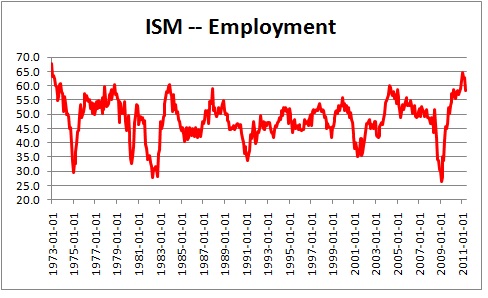
Fourth, the Institute of Supply Management produces a monthly report on conditions in the manufacturing sector. They survey current and expected economic conditions, orders, production, prices paid – and employment. Their survey is released on the first of every month. The ISM employment index fell 4.5 points in May from 62.7 in April to 58.2. However, earlier this year this index was at its highest level since 1973 – that is 38 years ago! So while the index declined somewhat in May as supply problems negatively impacted the manufacturing sector, factory owners remain upbeat about employment. Somebody out there is very desirous of hiring additional workers.
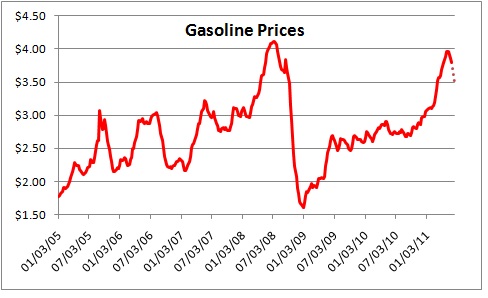
Finally, the increase in gasoline prices has caused consumers to spend more on gasoline and less on other goods and services. Suppose someone has a monthly income of $4,000 of which $300 is spent on gasoline. If gasoline rises by 50%, then their gasoline expense climbs by $150 to $450, which then means that there is $150 less to spend elsewhere. This has clearly contributed to some of the weakness we have seen in the past several months. But now gasoline prices appear to have peaked and are in the process of falling from $4.00 a gallon to $3.50. Thus, at least some portion of that $150 – probably about $20 – is now available to consumers for spending on other items and some of the earlier drag on the economy is in the process of being reversed.
We readily acknowledge that GDP growth has been weaker than we anticipated. But for all the reasons cited above we are reluctant to alter our view that the economy is currently experiencing nothing more than a short period of sluggish growth. The economic fundamentals remain sound and we continue to expect growth to accelerate significantly in the second half of this year.
Stephen D. Slifer
NumberNomics
Charleston, SC
Follow Me