
October 19, 2012
The Fed is not worried about inflation. It expects the inflation rate to remain a shade under its desired 2.0% pace from now through 2015. We agree. But two pieces of recent data are inconsistent with this rosy scenario.
First, consider housing. For two years builders simply did not build any significant number of new houses or apartment buildings. In fact, housing starts reached a record low level in the middle of 2009.
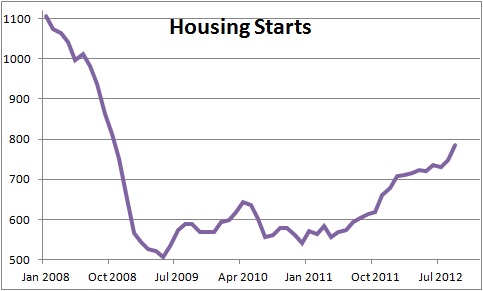
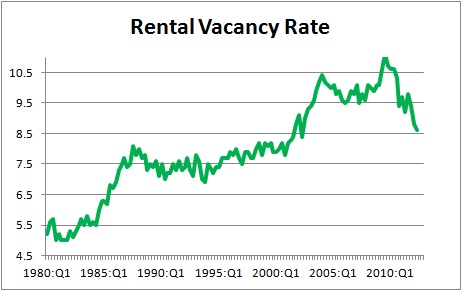
But the population did not stop growing and new households are being formed. People need a place to live. But they lost lots of money during the recession, they continue to worry about their jobs, and mortgages are difficult to attain. As a result, many are forced to rent. Vacancy rates for rental housing have declined to where they were at the beginning of 2006 when the housing market was red hot. In both cases there was excess demand for housing. In 1996 builders could not keep pace with the torrid pace of sales. Today builders are struggling to catch up after two years of building virtually no new apartment buildings.
Against this background rents have begun to rise. They started to climb at the beginning of 2011 and are now climbing at a 2.2% pace.
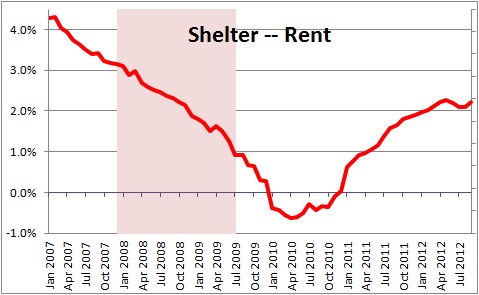
This is important because the shelter component represents 31% of the CPI – rents are 7%, and owner-equivalent-rent for homeowners is 24%. Given the shortage of available housing, this component is almost certain to climb over the course of the next year. Given its weight in the calculation of the CPI, a 1.0% further increase in rent from 2.2% to 3.2% would add 0.3% to the CPI. That is large enough to possibly push inflation above the Fed’s target.
Second, the full employment level of the unemployment rate is rising. There will always be some frictional unemployment as workers shift from one job to another or as firms go out of business. Economists used to believe that if the unemployment rate fell to 5.5% everyone who wanted a job had one. If the unemployment rate dips much below that level, wage pressures emerge because firms cannot find the workers that they need. The problem is that the full employment threshold seems to be rising. Consider the average amount of time workers are unemployed.

Currently, the average duration of unemployment is 40 weeks. The unemployment rate peaked at 10.0% and has now fallen to 7.8%, but the average duration of unemployment has not budged. It is at its highest level in 75 years. There is a clear mismatch between the skill set offered by these long-term unemployed workers and what employers need. Firms want tech savvy employees and many of these workers cannot meet that requirement. As a result, many could become permanently unemployed. If that is true, the full employment threshold is higher.
Today there are 4.8 million workers who have been unemployed for 27 weeks or longer. If one-third of them become permanently unemployed, the full employment threshold climbs to 6.5%. If one-half fall into that category, the full employment level climbs to 7.0%. The Fed thinks the magic number has not risen much. It pegs it at 5.7%. Nobody knows who is right. All we know is that the full employment threshold is rising, but the level is a matter of debate.
Consider the following. If the full employment level is 5.7% as the Fed believes and the unemployment rate today is 7.8%, the excess supply of labor should push wages lower. But that is not happening. The employment cost index – which includes both wages and benefits – has been inching its way higher for two years. If there is as much excess labor as the Fed expects, why aren’t wages falling? Labor costs represent about two-thirds of a firms overall costs. If wages continue to accelerate something has to give. Either earnings are going to get squeezed, or firms will be forced to raise prices. At this point we think that firms will eat some of these higher costs internally rather than raise prices.

The point is that these two pieces of data do not fit well with our benign outlook for inflation. For now we will continue to monitor the situation closely, but stay tuned.
Stephen Slifer
NumberNomics
Charleston, SC
Follow Me