
January 4, 2013
The good news is that Congress stepped back from the cliff and averted what would have surely been an economic train wreck in 2013. The bad news is that a tighter fiscal policy stance will still act as a brake on GDP growth this year. But rather than having higher tax rates and reduced government spending subtract 4.0% from GDP growth in 2013, it will slice growth by a less onerous 1.5%. Our expectation is that despite this tighter fiscal policy stance the underlying pace of economic activity will steadily accelerate throughout the year and come in at a rosy 2.7% pace compared to 2.0% in 2012.
Our leaders in Washington mitigated the potential negative impact on GDP growth this year by making the Bush era tax cuts permanent for most taxpayers. They did, however, increase taxes for those individuals earning more than $450,000. In addition, the Social Security payroll tax will rise by 2.0% which will reduce workers take home pay by the middle of January. And capital gains taxes will increase in 2013. These three factors should reduce 2013 GDP growth by roughly 1.25%. The remaining issue is the extent of the cutbacks in government spending which were scheduled to occur on January 1. Congress deferred those cuts for two months. After everything is said and done, cuts in government spending will probably slice another 0.25% from GDP growth. The net result is that GDP growth this year will be reduced by about 1.5% from this combination of higher taxes and reduced government spending. If Congress had not acted the negative impact would have been a devastating 4.0%. So instead of being an economic disaster, a tighter fiscal policy stance will become a more moderate economic headwind. Can the economy overcome this hurdle and still register respectable growth in 2013? We think so.
As we begin a new year our sense is that the economy is gathering momentum. A couple of factors are worth noting.
Employment gains are steadily getting larger. The average increase private sector employment was 181 in the final three months of last year. At midyear the comparable 3-month average increase was just 88 thousand.
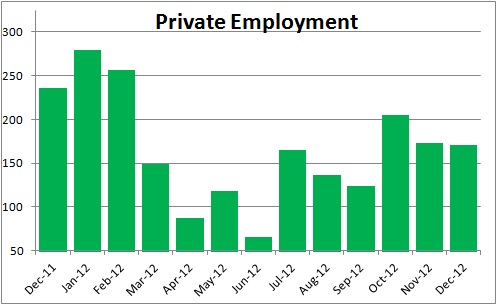
At the same time firms are working their existing employees longer hours in an effort to boost output. But the workweek has returned to where it was prior to the recession. If the pace of economic activity quickens in 2013, corporate executives will need to hire more workers to satisfy the demand for their goods and services.

Also, next month the Labor Department will revise upwards significantly the employment data for 2011 and 2012. Based on more complete data they have told us that from April 2011 through March 2012 private sector employment will revise upwards by 38 thousand from an average monthly increase of 170 thousand to an average gain of 217 thousand. This suggests that the increases in employment in subsequent months will revise upwards by a roughly comparable amount.
The housing sector is steadily gathering momentum. During the recession builders did not build enough new homes and apartments to keep pace with a growing population. Even though builders have sharply boosted production, the demand for housing continues to far surpass the supply. We need about 1.3 million new housing units each year; the current production rate is about 60% of what is required.

As the housing sector gathers momentum jobs in the construction industry will quicken. Monthly average rents and home prices will continue to increase. Rising home prices and record low mortgage rates will induce fence sitters to jump into the market and purchase a home before they can no longer to do so. Thus, it appears that a virtuous cycle in housing is now underway which will last for several more years.
Reduced uncertainty will boost hiring and investment. Given the fiscal cliff problem and the possibility that the economy could slip back into recession in the early part of 2013, firms deferred hiring and investment plans in the second half of last year. With that particular difficulty having been resolved, firms should now be more willing to hire additional workers. They should also be more willing to take advantage of record low corporate borrowing rates and ample cash to boost investment.
Thus, there is every reason to believe that despite a drag on growth coming from a tighter fiscal policy stance, economic activity will strengthen in 2013 and GDP growth of 2.7% should be attainable. If in the next couple of months Congress and the White House can find a way to compromise and resolve our longer-term budget issues, our 2.7% projected rate could be too low.
Stephen Slifer
NumberNomics
Charleston, SC
Follow Me