
June 13, 2013
The recession ended in June 2009. Five years later the expansion still appears vibrant and poised for growth. It is important to remember that recessions do not just happen. They are caused. Typically, the economy begins to overheat. Some sort of imbalance materializes that the Federal Reserve tries to counter by raising interest rates. While in a theoretical world higher rates eventually slow the economy and it magically glides onto a slower growth trajectory, in the real world that doesn’t happen. Higher rates ultimately cause consumers and business people to react simultaneously and the economy plunges into recession. But today the economy is not overheating, no imbalances are evident, and Fed action to raise interest rates is far into the future.
Five years of expansion may not seem like much of an achievement. But 100 years ago a typical business cycle lasted 4 years — 2 years of expansion followed by 2 years of recession. Our policy makers have gotten better. Since 1960 business cycles now average 7 years – 6 years of expansion followed by just 1 year of recession. In fact, the three longest expansions in U.S. history have all occurred since 1960 – the decade of the 1960’s, the decade of the 1990’s (which lasted a record breaking 10 years), and the early 2000’s. That is not an accident. The Federal Reserve has gotten better at what it does.
What imbalances might we look for to give us some hint of when this expansion might be aging?
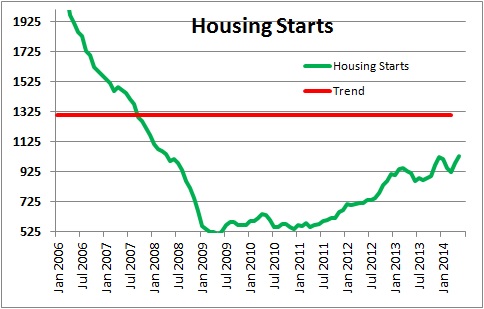
In 2007 the housing sector was red hot. Builders were starting (and selling) 2.0 million homes per year. But only 1.2 million new households were being formed each year. Once the recession hit the housing sector got crushed. Starts slipped to 0.5 million units per year, but 1.2 million new households were still being formed. Suddenly demand exceeded supply and that has been the case for the past six years. Clearly, the housing market is still recovering and not in danger of overheating.
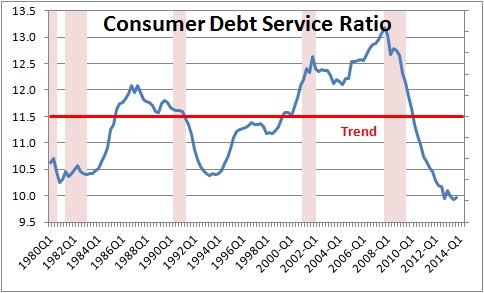
In the mid 2000’s consumers were highly leveraged and piling on debts. Debt outstanding was way out of sync with income. Once the recession began consumers paid down enormous amounts of debt. Today consumer debt in relation to income is the lowest it has been since the early 1980’s. Only in the past few months have consumers begun to crawl out of their shell and be more willing to take on debt.
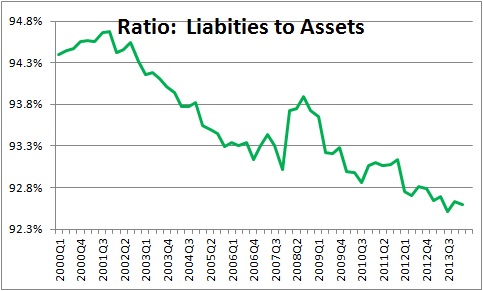
Like consumers, the banking sector was highly leveraged in the first half of the 2000’s. Once the recession hit contagion caused the problem to spread quickly throughout the entire financial community. In the past five years banks have sharply boosted their equity and all measures of risk have declined. Only now are banks showing a renewed inclination to make loans. In the past four months business loans, mortgages, and consumer installment loans have all begun to expand at a brisk pace.
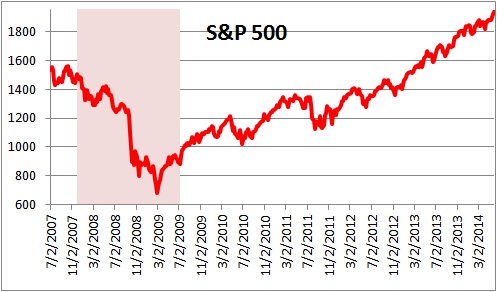
The stock market continues on a roll and sets a record high level every few days. Investors believe that the combination of moderate growth, low inflation, and higher rates still far into the future will bolster corporate earnings.
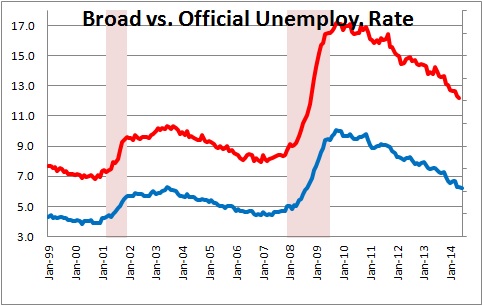
The Fed would get nervous if labor market was overheating which would ultimately push wage rates – and inflation – higher. But that is not happening. At 6.3% the official unemployment rate – which measures the number of people are that unemployed – is still higher than its presumed full-employment threshold of 5.5%. The number of people that are underemployed – i.e., people who are working part time who they would like full time employment, and people who have given up looking for a job – as measured by the broadest measure of unemployment, remains at an elevated level. Given the degree of un- and underemployment in the labor market the Fed is almost certain to remain on the sidelines for at least another year.
Finally, the Fed would get nervous if there were any sniff of inflation. Its preferred inflation gauge – the personal consumption expenditures deflator – remains far below its 2.0% target. While it has begun to rise a bit more rapidly in recent months the Fed has told us that it is willing to tolerate inflation higher than the 2.0% target as long as there is slack in the labor market. That will be the case for at least another year.

So happy birthday to the economy! Kudos to the Fed for keeping it going! Five years from now there is a good chance that we will be celebrating its 10th birthday.
Stephen Slifer
NumberNomics
Charleston, SC
Follow Me