
November 23, 2012
In a recent speech Fed Chairman Bernanke suggested that the economy’s potential growth rate may have been reduced and the full employment level of the unemployment rate may have risen. These factors could lower our standard of living and make it more difficult to shrink the budget deficit. Bernanke believes that any such deterioration has been modest and largely temporary. What if he is wrong?
The economy’s speed limit is the sum of the growth rates of the labor force and productivity. Why? Because the output of goods and services (GDP) can grow only if firms hire more workers or make their current work force more efficient (through increased productivity). Prior to the recession potential GDP growth was generally regarded as about 2.5%, consisting of roughly 1.0% growth in the labor force and 1.5% growth in productivity.
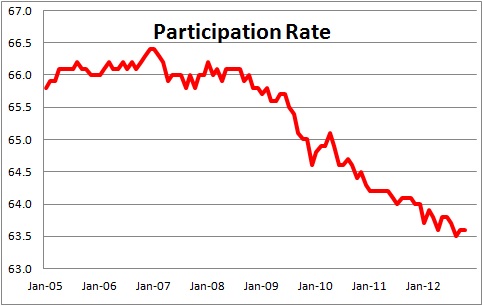
With respect to the labor force, the labor force typically grows at about the same rate as the population. In other words, the “participation rate” is fairly steady. But since the recession the participation rate has been falling. Why? First, there has been a mismatch between the technological skills that employers need and those that are available amongst the ranks of unemployed workers. This has resulted in a sharp increase in the average duration of unemployment. Unable to find a job, many unemployed workers eventually gave up looking for a job and the “participation rate” declined. At the same time, many older workers who became unemployed have chosen to retire which exacerbated the situation. Historically, population and the labor force have grown at about a 1.0% pace. Going forward, if the lower participation rate causes the labor force to grow more slowly, the potential growth rate of the economy will be correspondingly reduced.
The other part of the equation, the growth rate of productivity, is determined by the willingness of businesses to invest which is, in turn, a function of their ability to estimate a future revenue stream and the cost of production. Firms always have to worry about the vagaries of growth in the economy, the inflation rate, and interest rates. They can deal with that. But recently the deteriorating fiscal situation has sharply increased the degree of uncertainty. The fiscal cliff that is looming at the end of December has the potential to push the economy back into recession. By spring the debt limit will need to be increased. The last time that occurred in August 2011 political bickering heightened uncertainly which caused the stock market to nosedive and consumer and business confidence to collapse. Current uncertainty about the fiscal situation has caused investment spending to slow steadily throughout the year.

If this murky fiscal situation is not resolved, business leaders will be reluctant to expand their plant capacity or invest in the latest technology, both of which boost productivity. If this reduced willingness to invest slows the rate of growth of productivity from its historical average of 1.5% the potential rate of growth of the economy will be reduced.
What if, going forward, the labor force grows at 0.5% rather than 1.0%, and productivity climbs at 1.0% rather than 1.5%? That means that the economy’s speed limit will have slipped from 2.5% to 1.5% and two very bad things will happen.
1. Income. Slower GDP growth means slower growth in income. Rather than growing at 2.5%, income growth will slow to 1.5%. Because income is what consumers use to purchase additional goods and services, we will be less able to buy new cars, houses, electronic equipment, or go on vacation. In short, our standard of living will be reduced.
2. Tax revenue. Slower growth in income means less tax revenue which will make it more challenging for the federal government to shrink our current bloated budget deficits and reduce debt.
Mitigating the impact of the fiscal cliff early next year will support the transition of the economy back to full employment and reduce the deficit. A credible plan to put the federal budget on a sustainable long term path will reduce uncertainly, boost consumer and business confidence, reduce long-term interest rates, and support economic growth both today and in the future.
According to Bernanke, “Meaningful progress toward this end can be achieved now if policymakers are willing to think creatively and work together constructively.” Let’s hope he is right. The stakes are high.
Stephen Slifer
NumberNomics
Charleston, SC
Follow Me