
December 2, 2011
The unemployment rate fell 0.4% in November from 9.0% to 8.6%. Private sector employment rose by 140 thousand workers , and there were upward revisions of 42 thousand to the data for September and October. Clearly the labor market is gathering momentum.
While that is welcome news, the reality is that given our expected pace of GDP growth in 2012 and beyond, the unemployment rate will not drop back to its so-called full employment level of 5.0% or so until the middle of 2016. As the economy continues to strengthen gradually, monthly employment gains should climb to perhaps 175 thousand. But at the same time the labor force rises by about 100 thousand. This means that the ranks of the unemployed are falling by only about 75 thousand per month. When you work through the math, it will take until mid-2016 to decline to the 5.0% level at which rate (presumably) everybody who wants a job has one.

Unfortunately, the unemployment rate may never return to 5.0%. The longer people are unemployed the more difficult it is for them to get a job. Employers shy away from hiring long-term unemployed workers because of a belief that time their skills have become rusty or perhaps even obsolete in this rapidly changing technological world. Consider the fact that even though the unemployment rate fell 0.4% in November, the average duration of unemployment continued to climb from 39.4 to 40.9 weeks. It has not been that long since the depression. Clearly, the folks who got hired were not amongst the ranks of the long-term unemployed.
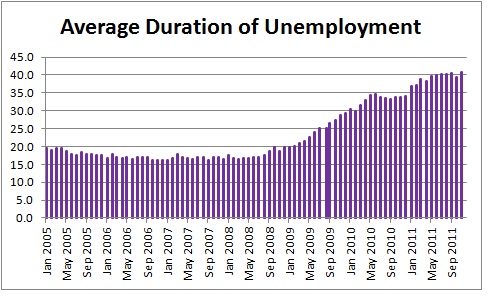
The Bureau of Labor Statistics tells us that 43%, or 5.7 million out of 13.3 million unemployed workers, have been without a job for more than six months. Almost certainly those people have burned through whatever savings they may have had. What then? Employers today are looking for people who are technologically savvy. Do these people have the skill set that employers are seeking? Probably not. This suggests that the so-called full employment level may no longer be 5.0%, but something higher. It is possible that many of these people will become permanently unemployable. It is too soon to say, but the so-called full employment level for the U.S. economy may have risen to 6.0% — or higher. We used to make fun of European countries whose unemployment rates were much higher than ours. It is time to stop snickering.
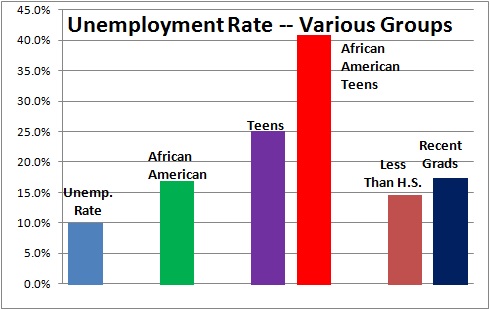
The other troublesome part of the November employment report is that the 0.4% drop in the overall unemployment was not shared by all demographic groups. The unemployment rate for whites, for example, fell 0.4% to 7.6%. The unemployment rate for blacks rose 0.4% to 15.5%. For Hispanics it was unchanged at 11.4%.
It is clear that within our population some groups are suffering worse than others. As noted earlier, the unemployment rate for African-Americans is 15.5%, for black teenagers it is in excess of 40%. For those without a high school degree the unemployment rate is almost 15%. And somewhat surprising is the fact that 16% of recent college grads cannot find a job!
Against this background, and given that 2012 is an election year, it is clear that our policy makers are almost certain to “do” something.
Even though the Fed is apolitical, it is impossible for a central bank to envision a protracted period of high unemployment and not feel compelled to help. With the Federal funds rate already at 0%, and more than ample reserves in the system, the only thing left to do is what the Fed calls “Operation Twist”. That means they sell some of their short-dated Treasury securities (like Treasury bills) and buy long-dated ones – like 10-year Treasury notes and mortgage-backed securities — in an attempt to lower long-term interest rates. It may not help much, but it sure won’t hurt.
The President and Congress will almost certainly take action in January. The parts of President Obama’s jobs’ bill that are likely to pass are an extension of unemployment benefits, and a cut in the payroll tax for employers, for workers, or both. This action will make the near-term deficit larger, but it will presumably be offset by spending cuts in subsequent years. Many will squawk about a near-term increase in spending with dubious spending down the road. Fair enough. But if the unemployment rate is going to remain elevated for years to come, can we afford not to do anything we can to help?
Stephen D. Slifer
NumberNomics
Charleston, SC
Follow Me