
January 3, 2014
At the end of October we learned that third quarter GDP growth was 2.8%. That growth rate has been revised upwards and now stands at 4.1%. While GDP expansion was clearly strong in the third quarter, most economists believe the gain is not overly impressive because a significant portion was caused by a build-up in inventories. They contend that firms will cut production to eliminate unwanted inventories and, if they are right, GDP growth in the fourth quarter will be weak – probably 1.0-1.5%. Think again. Fourth quarter GDP growth now seems likely to be at least 3.0% as every sector of the economy is on fire.
Consumer spending in the fourth quarter seems likely to be at least 4.0%. Data for October and November have already been released. December data are still missing, but even a modest gain in that month will boost spending for the quarter above the 4.0% mark which would be double the third quarter pace. Keep in mind that consumer spending represents two-thirds of GDP.

Inventory accumulation for the fourth quarter is unlikely to be much less than the $115.7 billion reported for the third quarter for a couple of reasons. First, if the third quarter inventory buildup was unintentional it presumably occurred because sales plummeted and firms got stuck with merchandise they did not want. In that event the ratio of inventories to sales would rise sharply. But during the third quarter and into October the monthly changes in sales and inventories were in lockstep. As a result, the inventory/sales ratio has been steady at its current level since mid-2012. Most likely firms are trying to boost inventories simply to keep pace with a pickup in sales. Second, inventories registered another strong gain in October which suggests that the fourth quarter buildup is on track to be roughly comparable to what it was in the prior quarter.

Construction spending has risen by 1.0% in each of the past three months – September, October, and November. While such spending has risen 5.9% in the past year, it has accelerated to a 13.6% pace in the past three months as both residential and nonresidential construction have surged. These figures suggest strongly that nonresidential investment is likely to gather momentum in the fourth quarter while residential investment accelerates from an already steamy 10.3% pace. Investment spending represents another 15% chunk of the overall economy.

Exports are on the upswing. Data for October are far higher than the third quarter average. If they remain at their current level exports could grow at a double-digit pace in the fourth quarter compared to 3.9% in the prior quarter. Trade is another 10% of the GDP pie.
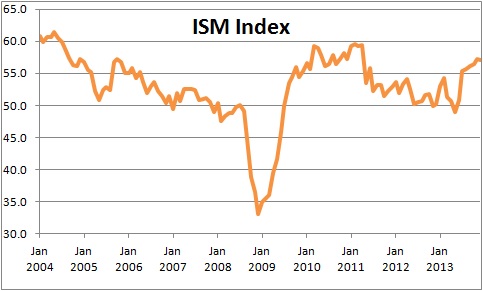
Finally, the Institute for Supply Management Index for the manufacturing sector increased for six consecutive months from May through November before retreating ever so slightly in December to 57.0. The ISM group indicated that if the December level was annualized it would translate into a 4.6% increase in GDP. While fourth quarter growth is not going to be that robust, the point is that the current consensus for fourth quarter GDP growth of 1.0-1.5% is way off the mark.
So what happens if economic activity is picking up steam? Several things. The current pace of 200 thousand jobs per month could easily climb to 225-250 thousand which would, in turn, reduce the unemployment rate to 6.0-6.5% by yearend. More jobs will create the income required for consumers to boost their pace of spending. Because the Fed has made it clear that it intends to keep rates low for some time to come the combination of more rapid growth and low rates will boost the stock market. The dollar will strengthen as investment opportunities in the U.S. become more attractive than elsewhere around the globe.
The economy looked good at the beginning of December. It looks even better now. But the economy grows in fits and starts. It would be premature to substantially alter our 3.0% GDP forecast for 2014 based on strong data for a couple of months in late 2013. But if our policy makers in Washington get out of the way and avoid policy blunders, the risk is that economic expansion this year could be rosier than the most optimistic economists currently expect.
Stephen Slifer
NumberNomics
Charleston, SC
Follow Me