
October 24, 2014
The Dow Jones Industrial average has changed by more than 200 points in 9 of the first 17 trading days in October. Such moves attract page 1 headlines and earn the top spot on the evening news. They are downright frightening as they unfold. Despite this daily volatility the cumulative drop has been a meager 2%. But what a ride! These wild gyrations are not confined to the stock market. The bond market, commodities, and currencies have all been similarly affected. This volatility will not go away.
For the past five years the world has been lulled to sleep. The Fed lowered short rates to 0% and told us rates were going to stay there for a protracted period of time. But suddenly the backdrop has shifted. The Fed plans to begin raising short rates by the middle of next year. When will it start? How quickly will rates climb? As expectations regarding future Fed policy ebb and flow, interest rate levels fluctuate.
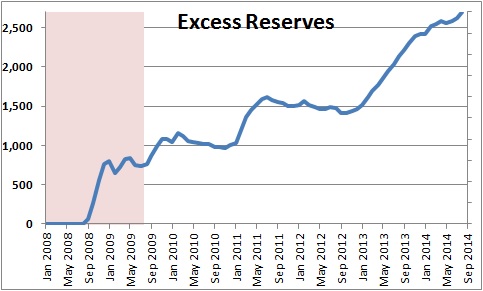
But more is afoot than just changes in interest rates. The Fed’s entire conduct of monetary policy is being transformed. Prior to 2008 excess reserves in the banking system were about $2.0 billion. If the Fed wanted to push interest rates higher it simply sold some Treasury securities, wiped out the excess reserves, forced banks to borrow from the Fed to get the additional funds they needed to lend, and interest rates rose. But now as a result of the Fed’s prolonged bond buying program there are currently $2.7 trillion of excess reserves. This is a game-changing event. It forces the Fed to alter the way it conducts monetary policy. It can no longer sell enough Treasury securities to create a shortage of reserves which had been the mechanism to push rates higher. However, it has developed a new game plan whereby it intends to increase the interest rate it pays banks on the reserves that they hold at the Fed. Presumably banks will leave most of their reserves in a risk-free account at the Fed rather than lend them out to riskier borrowers such as you and me. But this has never been done before. Will it work? What will be the unintended consequences?
Changes in monetary policy also impact the stock market. Higher interest rates will simultaneously slow the growth in revenues as sales slip, and increase the cost of borrowing as interest expenses rise. Investors must re-evaluate their earnings expectations. We happen to believe that the economy and the stock market can easily shrug off a series of gradual rate hikes and continue to climb. Not everybody agrees. Those differing expectations underlie the recent volatility.
If that is not enough, the revolution in the oil market is altering expectations for economic growth around the globe. Thanks to hydraulic fracturing and horizontal drilling U.S. oil production has surged in the past four years. Oil exports have quadrupled while oil imports have dropped 25%. The world is awash with surplus oil. Oil prices have fallen from $107 per barrel in the summer to $80. The drop in oil prices is a clear benefit for consumers, manufacturers that use oil in the process of production, and the transportation industry such as airlines and truckers. But it negatively impacts oil producers as their revenue stream plunges which could impact their ability and/or willingness to drill new wells next year. Longer term the United States will rely far less on OPEC as a source of energy. That has enormous political implications. How long will oil prices stay this low? If they rise, how far will they go? What might be the new equilibrium price of oil? Like the Fed’s conduct of monetary policy this is another game-changing event whose consequences have yet to be determined.
Given that interest rates will soon begin their ascent and that the entire way the Fed conducts monetary policy is about to be overhauled, the bond market has a lot to deal with. The change in the Fed’s behavior is unprecedented and no one can predict confidently how it will play out.
Higher interest rates and their ability to slow the pace of economic activity and reduce corporate earnings are of obvious interest to the stock market. Lower oil prices can counter some of the sting of higher interest rates, but they also produce winners and losers as some sectors fare well but others get hammered. Who will be the winners and losers? What is the net effect?
The commodity markets must wrestle with this sea change in oil prices. The consequences will not be determined for years to come.
The currency markets have a similar problem. For the last five years all of the major central banks were on the same page – the Fed, the European Central Bank, the Bank of England, and the Bank of Japan. They were all aggressively pushing rates to 0%. But now the Fed is about to raise rates. The Bank of England will soon head down the same path. The ECB is trying to find ways to further stimulate the European economy. The Bank of Japan is faced with an economy that is slowing. As some central banks go one direction while others do the opposite, currencies are the equilibrating factor. The dollar and sterling seem poised to go higher. The euro and the yen are likely to weaken. The currency market will not be immune to increased volatility.
Pick a market — stocks, bonds, commodities, or currencies. They are all on a rocky road to discovering an as yet unspecified new normal.
Stephen Slifer
NumberNomics
Charleston, SC
Follow Me