
April 3, 2015
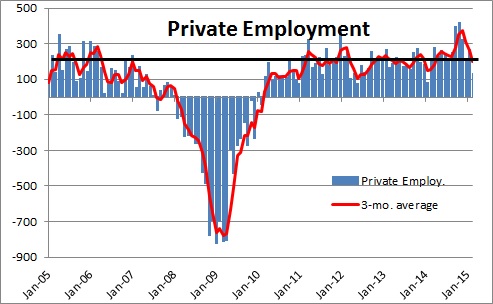
Private sector employment for March rose 129 thousand versus the 225 thousand increase that was expected. Previously reported increases for January and February were revised downwards. As a result, private employment in the past three months has risen on average 198 thousand per month. But rest easy these weaker-than-expected employment statistics are not indicative of weaker GDP growth in the months ahead.
First of all, the smaller-than-expected increase for March appears to reflect three important factors.
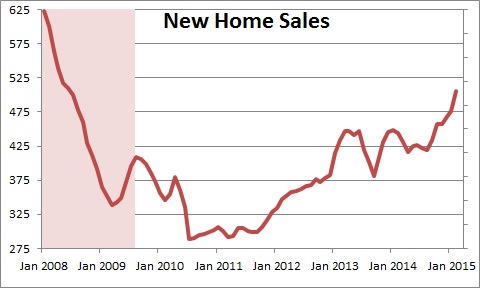
- Bad weather. Construction employment declined 1 thousand in March compared to an average increase of 38 thousand in the previous three months. But the construction sector has not softened. New home sales surged to a cycle high pace in February. Both single-family homes and apartment units are in short supply. Once the weather improves in the months ahead construction employment will resume its climb.
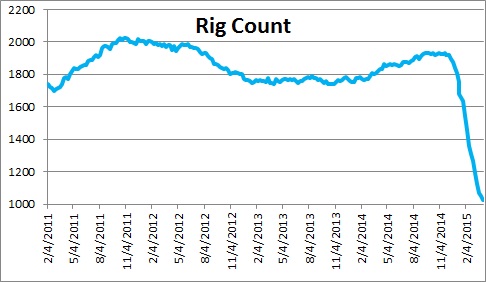
- Mining employment declined 11 thousand March after having fallen in both January and February. That compares to an average monthly increase of 4 thousand last year. This seems to reflect the sharp drop in oil prices and the number of oil rigs in operation. Once oil inventory levels begin to shrink and the number of rigs in operation stabilizes, the employment losses in this sector will come to a halt.
- Third, the West Coast dockworkers slowdown appears to have taken a toll on the manufacturing sector. Factory employment was essentially unchanged in February and March as the labor unrest intensified. This compares to an average increase in factory employment of 18 thousand per month in the previous twelve months. But the labor issues have now been resolved, ships waiting in the harbor will eventually be able to unload their cargo, and factories will soon get the parts necessary to resume a faster pace of production.
Thus, we do not attach any particular economic significance to the smaller-than-expected increase in private sector employment for March.
It is also important to recognize that previously employment was climbing at an unsustainable pace. For example, in the final three months of last year private employment was rising on average 376 thousand per month. Last month we noted that “this is a much faster pace of job creation than we can reasonably expect going forward. Private employment simply does grow much faster than about 225 thousand per month for any sustained period of time. Clearly hiring has been on a tear in recent months which probably cannot be sustained.” As a result, the smaller-than-expected increase for March and downward revisions to the previous two months are not all that surprising. We should expect employment gains going forward to average about 225 thousand per month which is as good as it gets.
Any time there is a weaker-than-expected economic statistic – particularly one as important as employment – the chorus rises that the Fed will delay the long-awaited first increase in the funds rate. We don’t buy that. We continue to expect the first rate hike at the FOMC meeting in June.
The Fed has told us that two things must happen before it will consider an increase in the funds rate.
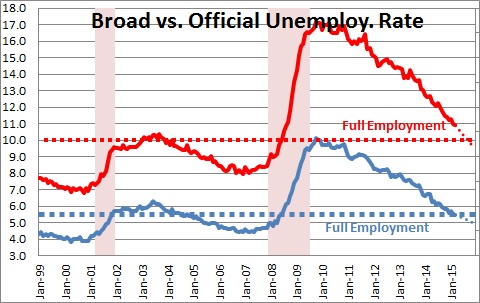
First the Fed will not raise rates until such time as the economy reaches full employment. The official unemployment rate for March remained at 5.5% (it was actually 5.47% and came very close to rounding downwards). By June we expect it to be 5.3% which is at the upper limit of the Fed’s estimated full employment threshold of 5.0-5.2%.
Second, the Fed has also said that it will not tighten until such time as the core inflation rate begins to approach its 2.0% target. Its preferred measure, the personal consumption expenditures deflator excluding the volatile food and energy components, is currently rising at a 1.3% pace. It should reach 1.5% by midyear and 2.0% by yearend. Thus, in our view the conditions that the Fed has cited as requirements for the first rate hike will be satisfied by the time of the June meeting.

With nominal GDP chugging along at about a 4.0% pace the economy no longer needs the stimulus provided by 0% short-term interest rates. It is time to gradually raise short rates to get them more in line with a “neutral” interest rate environment. Most economists consider the funds rate to be “neutral” when it is at about 4.0%. In our mind the issue is less about when they should embark on a path towards higher rates, than it is about the speed of adjustment once they get underway. Typically the Fed would raise the funds rate by 0.25% at every FOMC meeting which is every six weeks. Last month, however, it suggested that the rate of increase this time would be about one-half as fast or 0.25% every 12 weeks. That slow and gradual upward path means that rates will not reach the 4.0% “neutral” rate until the end of 2018.
Stephen Slifer
NumberNomics
Charleston, SC
Follow Me