
May 4, 2012
Weather distortions are distorting many economic statistics – the employment data in particular. During the winter months when not much happens, extremely mild winter weather caused more hiring than usual and the published data were biased on the upside. But then in the spring when employment normally rises sharply, the actual gain was less than anticipated and the data were biased on the downside. That creates an impression that the labor market has weakened appreciably. While true, the slowdown will be of very short duration.
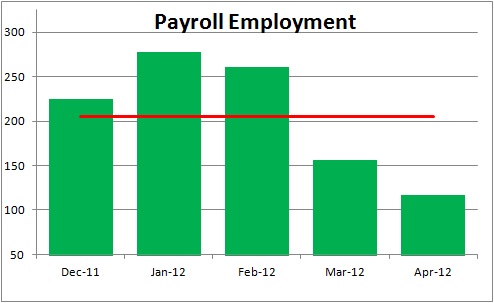
During the winter months from December through February, payroll employment increased 225-250 thousand each month. In March and April the monthly increases slipped to 125-150 thousand. But over the entire five month period the average increase in payroll employment has been a very respectable 205 thousand. Once the weather distortions have run their course, we should expect monthly employment gains of that magnitude.
An economist must always look at the data, determine whether any factors might be distorting it, and then combine that information with every other known economic statistic.
It is widely known fact that the U.S. experienced an extremely warm winter. As a result, we should have expected a number of economic statistics to appear quite strong during that period of time. Employment data, construction spending, and housing starts would certainly be affected, and perhaps to a lesser degree consumer spending and home sales. But then, in the spring one also had to expect the data to be biased downwards by a roughly comparable amount. Eventually the data will return to normal – which in this case means monthly employment gains in excess of 200 thousand.
This strikes us as very similar to what happened last year following the devastating earthquake and tsunami in Japan – but in reverse. At that time, Japanese output plunged in the spring. As a result, U.S. companies could not get the parts they needed, U.S. production fell sharply, and the economy softened – but only for a short while. Everybody knew (or should have known) that eventually Japanese production would recover, U.S. production would follow suit, and the economy would re-accelerate. This resulted in several months of weak economic statistics, followed by several months of very strong data as the economy rebounded. But many economists interpreted the initial weak data as a sign that the economy was going to dip back into recession. That perception negatively impacted the stock market and consumer confidence. But eventually the economy rebounded and fears of a renewed recession fell by the wayside.
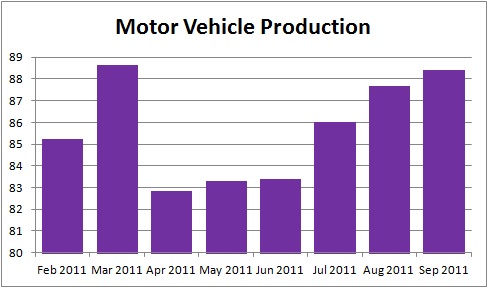
If the economy is currently in the process of slowing down it would show up in other leading economic indicators and that is not happening. The stock market continues to trade very close to its highest level thus far in the expansion. The consumer shrugged off rising oil prices in the first few months of this year and consumer confidence is also near its high for the cycle. Consumers have paid off enormous amounts of debt in the past few years and are once again spending and borrowing freely. After a few weeks on the high side, layoffs have retreated close to their low point for the cycle. Factory orders continue to climb and the backlog is rising. Manufacturers need to boost production to satisfy this increased demand. And the housing sector has begun what appears to be a vigorous recovery. Meanwhile, oil prices have reversed direction and begun to fall.
The unusually mild winter caused data in the first three months of the year to be surprisingly strong. But the economy was not nearly as strong as it appeared then. Now in the spring as weather conditions return to normal the data appear somewhat weaker. But the economy is not as weak as the most recent data suggest. On balance, the economy may jump around from month to month, but the combined impact from all of these economic statistics suggests that GDP growth is moderate for now, but it is in the process of strengthening. We continue to expect growth for the year of about 3.0%
Stephen Slifer
NumberNomics
Charleston, SC
Follow Me