
March 30, 2012
Recent economic data suggest that the economy is expanding at a reasonably rapid pace. We continue to anticipate GDP growth of 3.0% in 2012 (2.5% in the first quarter), monthly jobs gains that average 225-250 thousand, and a drop in the unemployment rate to 7.6% by yearend. While we do not lie awake at night worrying about what could go wrong, it is always prudent to evaluate the various possibilities.
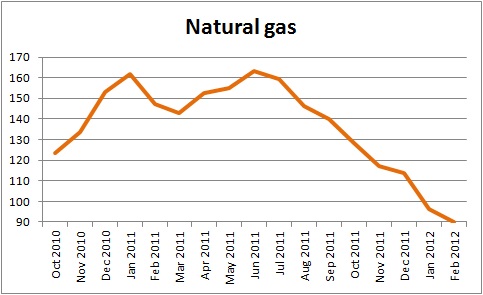
Oil Prices. Most economists seem to put this at the top of their list of concerns. Clearly, rising gasoline prices capture a lot of attention in the press. Most economists suggest that this factor could result in substantially slower growth in the quarters ahead. While higher gasoline prices will probably shave a few tenths of a point off of GDP growth, the increase thus far should not be too problematical for several reasons. First of all, last year gasoline prices rose 50% and reached $4.00 per gallon. That spike in prices was alarming. This year gas prices have once again hit $4.00 per gallon, but the increase since yearend has been one-half that amount. Because gasoline has tested this level previously and we survived, it somehow seems less threatening. Keep in mind that the stock market and consumer sentiment are currently at their highest levels thus far in the cycle despite rising oil prices. Second, gas prices always rise in the first half of any year in advance of the summer driving season, but then reverse direction and decline in the second half. There is no reason to think that this year’s performance will be any different. Third, some of the sting of rising gasoline prices is being offset by an equally impressive, but less discussed, drop in the price of natural gas. In our opinion, gasoline prices will have to rise much farther to, say, $5.00 per gallon to present any meaningful impediment to growth.
Slow Growth/Recession in Europe. There is no question that GDP growth in Europe is slipping as fiscal restraint becomes a reality. The OECD suggests that European area growth will slow from a 1.6% pace in 2011 to 0.2% in 2012. The IMF projects that growth will moderate to 1.1%. Let’s put this in perspective. Trade is 15% of our economy. Trade with Europe is 22% of the 15%, which means that trade with Europe represents 3.3% of our economy. If European GDP growth slows by 1.0% as these experts suggest, it would curtail GDP growth here in the U.S. by 0.3%.
Slower Growth in China. Because China is such a big trading partner of the U.S., a growth slowdown in that country captures attention. But it is important to remember that we import a huge volume of goods from China. Indeed, Chinese imports represent 20% of the total. But exports to China – which is what would be affected by slower growth in that country — are just 7%. The OECD and the IMF suggest that GDP growth in China will slow by about one percent in 2012 from 9.2% to 8.2%. Going through the same exercise described above, a 1.0% growth slowdown in China will shave U.S. GDP growth by an imperceptible 0.1%.
While slower growth in Europe and China will probably have a modest negative impact on GDP growth in the U.S., one other point is worth noting. The U.S. imports lots of goods and services from both Europe and China. If GDP growth in the U.S. turns out to be 3.0% in 2012 (as we expect) rather than the 2.0% pace that is generally anticipated, the slowdown in each of those areas will be substantially less than projected because of faster growth in their exports to this country.
War between Israel and Iran. This is a far more troubling scenario than any of the possibilities suggested earlier. It would presumably result in Iran attempting to close the Strait of Hormuz either by mines or missile attacks. Given that 20% of the world’s oil flows through this strait, any disruption in the flow of oil – even temporary – would send oil prices soaring. There is currently a lot of posturing by both sides. While presumably no such action will occur prior to the U.S. election in November, this situation bears watching because it would significantly alter the economic landscape if it were to materialize.
Stephen Slifer
NumberNomics
Charleston, SC
Follow Me