
May 15, 2015
It has been a rough first quarter as one allegedly temporary factor after another has caused GDP to actually decline in the first few months of the year. It is easy to dismiss some factors (like weather, and labor disputes) as being temporary in nature, but there comes a time when sufficient evidence has accumulated that even relatively bullish economists (like ourselves) are forced to conclude that the economy has gone off the rails and our forecasts are wide of the mark. Is this one of those times? We don’t think so.
We know the causes of the first quarter weakness. Bad weather kept consumers inside for a couple of months during the winter. But spring has arrived and sales should rebound. The labor dispute amongst West Coast dockworkers hammered exports, prevented retailers from getting the goods they needed for sales and manufacturers from getting the parts they required to maintain production. But the strike has now ended and exports and imports should rebound. The sharp drop in oil prices caused drillers to cap less productive wells. But oil prices have rebounded from $45 per barrel to $60 so the slide in drilling activity should soon come to an end. Thus, the negative impact on the economy from these factors should soon run its course and GDP growth is widely expected to rebound.
Having said all of that, retail sales were expected to rebound in April but, instead, sales for April were unchanged. The tax man seems to have altered the outcome. It turns out that tax payments to the Treasury in April were $57 billion larger than last year and produced the biggest monthly budget surplus on record. Writing a huge check to the IRS in April likely curtailed consumer’s willingness and/or ability to spend.
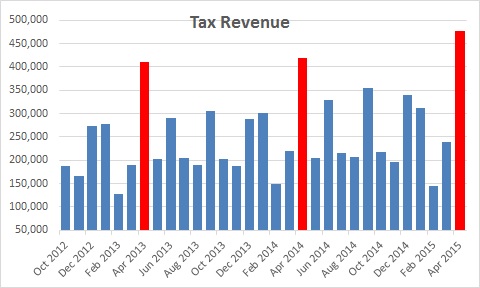
While tax payments resulted in soft spending in April, the fact that tax receipts were so high is an indication that consumer income last year was higher than expected and, as a result, income tax payments were not covered by withholding. Because nobody pays taxes willingly tax receipts are a fairly good barometer of strength in the economy. In fiscal year 2014 tax receipts were 8.9% higher than in fiscal 2013. In the first seven months of the current fiscal year tax receipts continue to be 8.9% higher than they were in the first seven months of last year. These data suggest that income has continued to climb which, in turn, suggests that the pace of economic activity has not slowed appreciably.
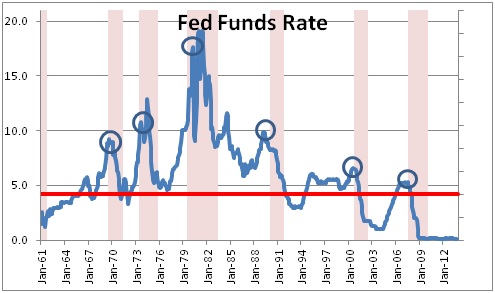
It is important for us to remember that long-lasting economic slowdowns do not just happen, they are caused. Typically they are caused by the Federal Reserves which pushes interest rates to a sufficiently high level that the economy falls over the cliff into recession. In fact, the U.S. economy has never gone into recession until such time as the Fed has pushed short-term interest rates above the so-called “neutral rate”. Today the funds rate is 0%, the neutral rate is about 4.0%. Even if the Fed begins to raise rates in June, the funds rate will not approach the neutral mark until the end of 2018.
Sometimes economic slowdowns can be caused by an increase in tax rates but that is not a factor today.
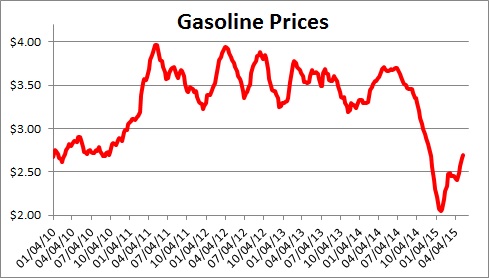
Furthermore, the recent drop in gasoline prices is providing a tailwind to the pace of consumer spending. Yes, gasoline prices have recently risen from a low of $2.05 per gallon to $2.70, but they should not rise much further and remain 26% lower than they were at this time last year. Remember, too, that all those recently capped wells can be quickly and relatively cheaply brought back on line if oil prices should rise by any appreciable amount. Lower gas prices are here to stay.
When the economy slows we tend to see employers become more cautious and begin to lay off people. Employment growth slows. But initial unemployment claims today are at a 15-year low. Monthly employment gains continue to average about 225 thousand. No softness in the labor market.

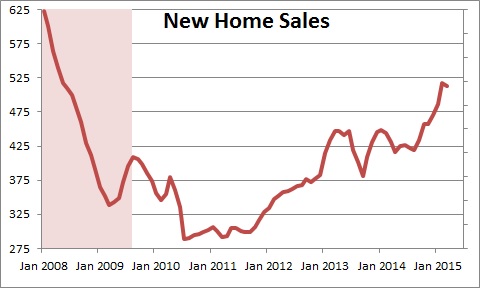
Because housing is such a large part of any consumer’s budget, when consumers get nervous it tends to show up first in home purchases. But new homes are selling at the fastest pace thus far in the expansion and seem to be accelerating. Existing home sales are not far behind. No weakness here.
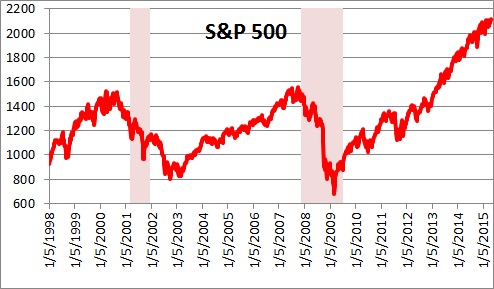
And then there is the stock market which continues to climb and is currently at a record high level. These leading indicators of economic activity all suggest strongly that the pace of economic activity is not going to remain subdued for long.
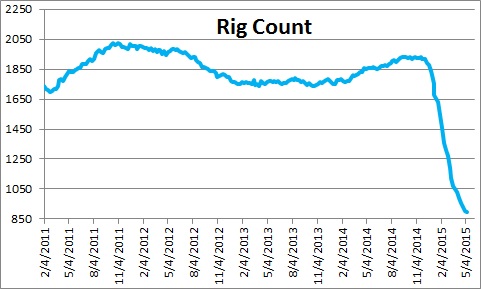
But we have to concede that the economy will not be as robust in 2015 as we had expected in December of last year. In our year ahead forecast we had expected GDP growth this year of 3.3%. Given what has happened in the first four months of the year we have sliced that to 2.8%. Without a doubt the drop in oil prices whacked drilling activity more than we had expected. The number of rigs in use today is essentially one-half the number of the rigs in production at the end of September last year when oil prices began to collapse.
It may also be that slower growth overseas combined with reasonably robust growth in the U.S. is curtailing the growth of exports and bolstering imports. We know that the trade gap widened dramatically in the early part of the year. But whether this is a result of growth differences between the U.S. and elsewhere, or simply muddled data caused by the dock workers slowdown is unclear. Most likely it is some of both.
The bottom line is that 2015 is off to a rocky start, but the predominance of evidence in the form of a variety of leading economic activities suggests that we should not get too excited about the first quarter GDP decline. The economy is fine but, admittedly, a bit less fine that we had expected four months ago.
Stephen Slifer
NumberNomics
Charleston, SC
Follow Me