
November 4, 2011
The past week or so has provided solid evidence that the economy has shrugged off its spring and summer slump. GDP growth accelerated to a 2.5% pace in the third quarter compared to growth rates of 0.4% and 1.3% in the first two quarters of the year. Private sector employed climbed by 104 thousand in October which, when combined with upward revisions to each of the previous two months, resulted in an equivalent gain of 188 thousand. Thus, the growth trajectory for the economy has shifted to the upside. While headwinds will almost certainly curtail the pace of expansion for a while longer, there are early signs that those headwinds are beginning to abate.
Housing. The 2008-09 recession was triggered by the collapse of the housing sector which has yet to recover. That has held down both GDP growth and job gains for the past couple of years. Typically, in the first two years of expansion, construction employment flattens out after having fallen considerably during the recession. For example, in the first 24 months of the previous two expansions, construction fell on average 4 thousand per month. In the first 24 months of this upturn, construction jobs have declined by 20 thousand per month.
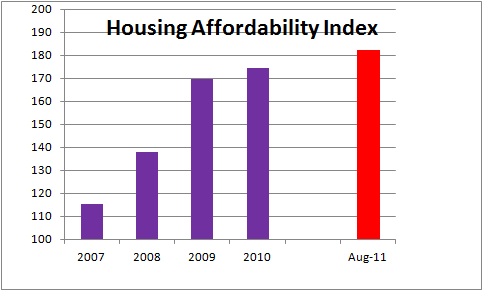
Having said that, the housing sector is poised for a rebound. Home prices have fallen 30% from their peak, mortgage rates are at record low levels of 4.0%, and slow growth in employment is allowing consumer income to rise slowly. As a result of these factors, houses today are more affordable than they have been in years. The turnaround in housing will occur once the economy works its way through the pile of foreclosures already in process, hopefully by the spring of 2012.
State and local government. State and local governments are required by law to produce balanced budgets. Given the recession and subsequent slow growth in the economy, their budgets have come under pressure which has triggered significant job losses for teachers, firefighters and the police. Typically, in the first two years of an expansion, state and local government employment rises on average 25 thousand per month. But since the end of this recession in June 2009, state and local government employment has fallen by 22 thousand per month. However, tax revenues for these government entities have improved in recent months which suggests that the bulk of these government related job losses may be behind us.
Because of the combined weakness in construction and state and local governments, payroll employment has been held back by 63 thousand jobs per month for the first 24 months of the expansion. This means that 1.5 million fewer jobs have been created in that period of time than in the comparable period of previous upswings.
Greek Tragedy. For almost two years countries around the world have been trying to deal with the enormous amount of Greek debt outstanding. It is difficult to quantify its impact on the U.S. economy, but it has clearly resulted in considerably more stock market volatility, a loss of confidence for both consumers and businesses and, almost certainly, reduced willingness to spend and invest. For now it appears that with an approved 50% haircut on outstanding Greek debt, and a renegotiated bailout package which enables it to borrow up to 100 billion Euros, Greece will avoid the possibility of a near-term default. Having said that, the situation remains fluid and news headlines on any given day can trigger wild market swings. One thing to keep in mind is that a Greek default, even if it were to occur, will create far less difficulty than the bankruptcy of Lehman Brothers in 2008. First, it is a problem that has been talked about for two years. What creates problems for markets are surprises; this is not a surprise. Furthermore, bank capital positions in both the U.S. and Europe have been fortified in the past couple of years which should allow them to withstand a Greek default if it should occur.
While it is clear that GDP growth and employment in the first two years of expansion have been held back by strong headwinds, there are early indications that those headwinds are beginning to diminish.
Stephen Slifer
NumberNomics
Charleston, SC
Follow Me