
March 21, 2014
At its most recent gathering the Federal Reserve’s Open Market Committee formally abandoned the unemployment rate as a benchmark for changes in policy. That was widely expected and is, in fact, a good thing. The markets, however, want a simple guide to monetary policy. They want to look at one or two indicators and know exactly how the Fed is going to respond. But that is not possible. The economy is extremely complex and one or two indicators cannot accurately portray that picture. To effectively carry out policy the Fed needs to look at everything. It has always done that, and will continue to do so. Even though the Fed has given up on the unemployment rate it has not left us rudderless. Indeed, it has told us in fairly explicit language what to expect.
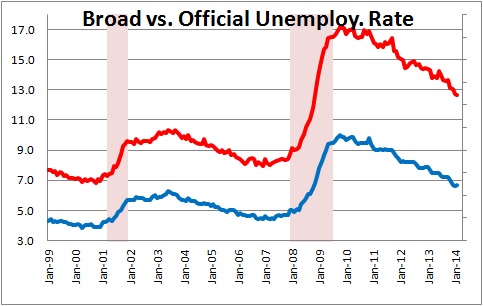
The Fed gave up on the traditional unemployment rate as a policy guide because it is not providing an accurate assessment of the labor market. The unemployment rate currently is 6.7%. It has fallen much more rapidly than anyone expected. Part of its rapid decline is attributable to baby boomers retiring and dropping out of the labor force. Thus, some portion of the decline has been caused by demographics and not by an improving jobs market.
Many people have been out of work for an extended period of time, others have given up looking for a job, and still others are being forced to work part time when they would like full time employment. Thus, broader measures of the unemployment rate may more accurately portray the current state of the labor market. The broadest measure, U-6, is currently 12.6%. Prior to the recession it was about 8.0%. Thus, the labor market has not improved as much as the official rate would suggest. For the Fed to begin raising the funds rate just because the official rate hits 6.5% – which is likely to happen within the next couple of months – would not seem to be an appropriate policy response.
While the Fed may have downgraded the status for the unemployment rate, it continues to provide guidance about future policy changes. Three t points are worth noting:
- The Fed is not going to raise short-term interest rates any time soon.
- Once the funds rate begins to climb its upward trajectory will be slow and gradual.
- Fed officials will warn us well in advance of any possible changes in policy.
The first step for the Fed is to eliminate its bond purchase program. It has trimmed its monthly purchases by $10 billion at every FOMC meeting. The cutbacks began in December and purchases have slowed from $85 billion per month at its peak to $55 billion currently. If this trajectory continues bond purchases will be eliminated by the end of October.
With respect to short rates the Fed has said it will maintain the current target range for the federal funds rate “for a considerable time after the asset purchase program ends.” In the press conference following the FOMC meeting Yellen suggested that a considerable time might be “something on the order of around six months.” If the bond purchase program ends in late October the first hike in the funds rate could occur by the spring of 2015. We had been expecting it to happen by the middle of next year. Either way the first action on the funds rate is at least another year down the road.
Once it begins to lift the funds rate the Fed will proceed slowly. The Fed provides expectations from the reserve bank presidents regarding the future course of the funds rate. By the end of 2015 they expect the funds to be about 1.0%. By the end of 2016 they anticipate it will climb to 2.0-2.25%. They also tell us that a “neutral” level for the funds rate is around 4.0%. While they were not asked specifically about their expectation for 2017, it is not unreasonable to assume the funds rate hits the 4.0% threshold by the end of 2017.
It is important to note that the U.S. economy has never fallen into recession unless the Fed has raised the funds rate above that so-called “neutral” rate. If that is not going to occur until the end of 2017, it is difficult to envision the U.S. economy dipping into recession until 2018 at the earliest. That is four years from now.

The bottom line is that the Fed may have downgraded the importance of the unemployment rate, but it continues to provide us with a fairly clear assessment of its intentions. To fully understand policy going forward it is imperative for us to listen to what Fed officials say and rely less on a single indicator.
Stephen Slifer
NumberNomics
Charleston, SC
Follow Me