
September 25, 2015
At the press conference following the September 17 FOMC meeting Fed Chair Yellen was asked how much the Fed was counting on the housing market for growth going forward especially since the committee sees rates rising. She said, “We are envisioning further improvements in the housing market. It remains very depressed. (Emphasis added). Housing starts are below levels that seem consistent with underlying demographics, especially in an economy that’s creating jobs.”
While Yellen is correct that housing starts remain below levels that seem warranted, one can hardly characterize the housing market as “very depressed.” Her statement was highlighted by the press and creates, in our opinion, a very misleading assessment of the housing market.
We would characterize the housing market as “hot”. She says it is “very depressed”. It is hard to reconcile those two statements. Somebody has it wrong. Let’s look at the facts and you can decide for yourself. Existing home sales are clearly on the rise. After rising sharply for three consecutive months they took a breather in August. Why the sudden pickup?
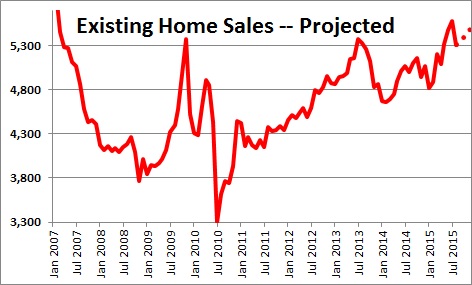
In our opinion, the sales surge is partially attributable to the fact that younger adults are finally moving out of their parents’ house and venturing out on their own. They are forming households. Since October of last year there has been a dramatic increase in the number of new households being formed. The Census Bureau tells us that since 2000, on average, 1.2 million new households are formed every year. But that rate of formation is not steady. For example, in the first five years of the expansion household formation was far below average because younger adults could not find jobs. They were also, in many cases, saddled with student debt. They could not afford to buy a house. They could not even afford to rent. Thoey had to live at home with their parents. But now times have changed. They have a job and seem to feel more comfortable about their financial situation. As a result, they are moving away from home. As they do so they need a place to live. It could be a house. It could be an apartment. There can be little doubt that this pickup in household formation is a significant contributing factor in the recent surge in home sales.

For those younger adults who choose to rent rather than buy, they can hardly find an available apartment. The vacancy rate for rental units is the lowest it has been in 30 years!
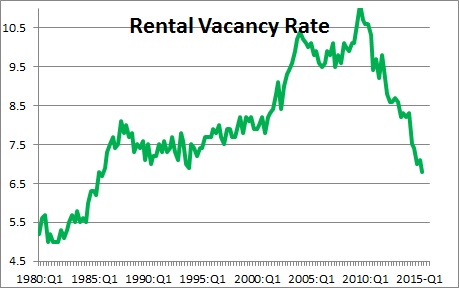
Because homes available to purchase and apartments available to rent are in such short supply home prices have risen 5.0% in the past year. Rents have risen 6.2%. It is not clear what adjective one should use to describe the housing market. “On fire” comes to mind. “Hot” is another possibility. “Very depressed” does not seem to fit.
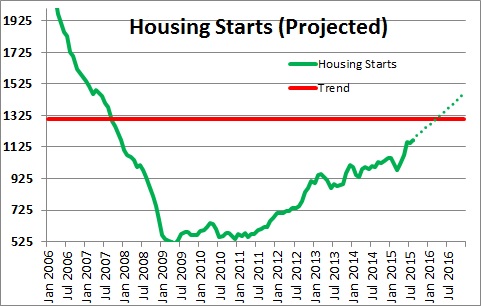
Builders have been struggling to catch up with demand. As Yellen notes, housing starts are at a level that is below what one might expect given an economy that is creating jobs. That is true.
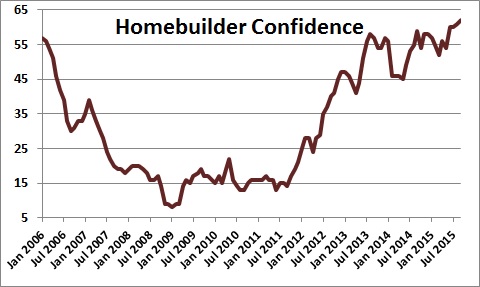
But builders are the most confident they have been in a decade.
The reason starts have not risen more sharply is because builders are having trouble finding enough skilled workers to significantly boost the pace of construction. Even so, housing starts in the past year have risen an impressive 17.1%. In the housing sector demand far outstrips supply. That is a situation in which sales, starts, and prices will continue to climb. The housing sector is not “very depressed”.
As long time readers of this column know I have the utmost respect for Fed officials. I readily acknowledge a positive bias because I was fortunate enough early in my career to spend a decade at the Board of Governors of the Fed in Washington, D.C. I have never run across a smarter more dedicated group of professionals. If we have to entrust control over the path of interest rates to any group I am very happy that the Fed is in charge.
I also understand the intense scrutiny that a statement by any Fed official is given — whether that is Chair Yellen, a Fed governor, or any Federal Reserve Bank president. All of us as consumers, business owners, and investors hang on their every utterance. It is very difficult in a speech, and even more challenging in a press conference, to express every thought clearly and concisely. For the most part this group of people does a good job of telling us what motivates their action.
But in this particular instance Chair Yellen’s characterization of the housing market as “very depressed” is highly misleading. I am not convinced that is exactly what she meant. But that is what she said and, unfortunately, it makes all of us worry that the Fed knows something that we don’t. No wonder the markets are jumpy!
Stephen Slifer
NumberNomics
Charleston, SC
Follow Me